
AI Automation
Practical AI for the work your business does every day.
Find useful ways to reduce repetitive work, organize information, and support your team. Malachite Business Solutions helps you assess opportunities, choose tools, and test AI-enabled workflows around a clear business need.

Start with a task that takes more effort than it should.
Look for work that repeats, involves searching through information, or requires the same preparation each time. These are examples we can assess together:
Organize incoming requests
Explore ways to classify inquiries, prepare a summary, and route them to the right person, with review where needed.
Find useful information
Help your team search approved documents and prepare answers that can be checked against the source material.
Prepare drafts and updates
Turn structured inputs or notes into first drafts of routine messages, reports, or content for your team to review.
Explore an example
Where could a useful pilot begin?
Choose a type of work to see a possible preparation step and the review that stays with a person.
Illustrative workflows using sample data
Fictional input
“We’d like to discuss a website refresh. We have photos, but we’re still working out the content and timing.”
Fixed sample content. No live AI or connected accounts.
Organize what is known.
- Summarize the request and available material
- List unanswered questions about scope and timing
- Prepare a draft for a person to check
Check the original message, correct the summary, and approve the next step.
Fictional input
A team member needs to find the workshop cancellation terms in the business’s approved reference documents.
Fixed sample content. No live AI or connected accounts.
Keep the source close.
- Search only the agreed reference material
- Prepare an answer with the relevant source
- Flag missing or conflicting information
Check that the source is current and that the answer matches it before using the response.
Fictional input
Project notes include completed page drafts, two open content questions, and a review meeting still to be arranged.
Fixed sample content. No live AI or connected accounts.
Prepare a useful first draft.
- Separate completed work from open questions
- Draft a short progress update
- Keep dates and commitments unconfirmed until reviewed
Check facts, edit the tone, and confirm responsibilities before sharing the update.
Choose the tools after understanding the work.
We start with your process, available information, and the result you need. Then we compare suitable options, including whether a simpler automation would do the job.

Flexible across platforms
We work across tools and models from OpenAI, Anthropic, Google, and xAI, as well as local models where appropriate. Selection depends on the task, data requirements, integrations, and operating costs.
For multi-step work, we can assess agents and the software that coordinates their tools, permissions, and review points. We define what the system can do before connecting it to business operations.
Move from an idea to a tested workflow.
A focused pilot gives you something concrete to review before deciding whether to expand.
Discover
Map the task, people, data, and current effort. Agree on what a useful result would look like.
Choose
Select an initial use case and compare tools against your requirements and budget.
Connect
Build a limited prototype with agreed inputs, integrations, permissions, and review points.
Review
Test representative examples, check errors and costs, and decide what to refine, expand, or stop.
Define the deliverables together.
Your project scope can include:
Workflow discovery
A map of the current process and a shortlist of opportunities prioritized by usefulness, effort, and risk.
Tool and model evaluation
A comparison of suitable options, their tradeoffs, and expected operating costs.
Prototype and integrations
A working pilot connected to the agreed systems or test environment.
Evaluation and review rules
Test cases, acceptance criteria, and clear points for human review or escalation.
Team guidance
Documentation and practical guidance for using the workflow and recognizing its limits.
Handoff and next steps
Agreed ownership, monitoring responsibilities, and recommendations for maintenance or further development.
Keep people and responsibilities in the process.
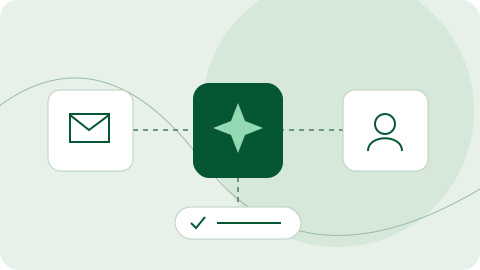
Before a pilot uses business data or takes action, we agree on access, data handling, approval points, and what should happen when a result is uncertain or a connection fails.
Customer-facing messages and other consequential actions can require approval. We define those boundaries with you and test the workflow against them.
We also agree on who will review performance, maintain connections, and approve changes after handoff. Ongoing support is scoped separately.
Questions before you start
Do I need to know which AI tool I want?
No. Start with the task or problem. We can help assess whether AI is useful and compare suitable tools before committing to a build.
Can you work with the software we already use?
We first check the available integrations, access permissions, and technical limits. The project scope identifies what can be connected and where a manual step or another approach is needed.
What is an AI agent, and would we need one?
An agent uses an AI model and connected tools to carry out steps toward a task. Whether it is suitable depends on the work and the amount of control required. A simpler workflow may be enough.
How will our business information be handled?
We review the data involved, who needs access, and the proposed tools’ handling of that information before the pilot. We agree on approved data sources and account settings; any additional requirements are addressed in the scope.
Can we start with a small project?
Yes. A focused discovery engagement or pilot can test one use case before a wider rollout. We agree on the deliverables, review criteria, schedule, and price first.
Will this save time or run without supervision?
That depends on the workflow and the results of testing. We evaluate useful measures, such as time spent and corrections needed, and define where human review remains necessary. Specific savings or fully autonomous operation are not guaranteed.
Tell us which task you would like to make easier.
Describe the work, the tools you use, and where your team gets stuck. We can start with a conversation about a useful first step.